
St. Mary's Catholic Primary School Logo

St. Mary's Catholic Primary School

Fiat Mihi

  • [email protected]
  • 01642 455309
  • Our School
    • About Us
      • Welcome from the Headteacher
      • Mission, Ethos & Values
      • Our Staff
      • Our Trust
      • Vacancies
    • Catholic Life
      • Jubilee Year: Pilgrims of Hope
      • Year of Mary
      • Called to Serve
      • Catholic Ethos
      • Catholic Social Teaching
      • Chaplaincy
      • Collective Worship
      • Laudato-Si
      • Mini Vinnies
      • Mission in Action
      • Our Parish
      • Religious Education
      • Stewards of Creation
    • Governance
      • Link Governance Framework
      • Interested in Being a Governor
      • Governor Handbook
      • Governing Body Membership
      • Governing Body Meeting Attendance
      • Memorandum of Understanding
      • Code of Conduct for Governors
  • Parents & Pupils
    • Key Information
      • Admissions
      • Apply for Free School Meals
      • Attendance
      • Breakfast & After School Club
      • Further Information – Parents
      • Further Information – Pupils
      • Holiday Request Form
      • Ofsted, Exams & Diocesan Reports
      • Ofsted Parents View
      • PE & Sports Premium
      • Policies
      • Prevent Duty
      • Pupil Premium
      • Remote Education
      • Safeguarding & Child Protection
      • Digital Resilience
      • Special Educational Needs Provision
      • School Meals
      • School Uniform
      • Timing of the School Day
      • Mental Health & Wellbeing
    • Curriculum
      • Curriculum Overview
      • Treehouse Programme
      • i Thrive
      • Exceptional Education For All
      • British Values
      • Year 6 Transition (Step 7)
      • NPCAT Sport
      • NPCAT Futureproof
    • News & Events
      • Newsletters & Publications
      • School Calendar
      • Term Dates
      • Trust Events Calendar
      • Diocesan News
    • EYFS
      • Early Years
      • 2 Year Old Provision
      • 30 Hour Provision
  • Statutory
St. Mary's Catholic Primary School Logo
  • Our School
    • About Us
      • Welcome from the Headteacher
      • Mission, Ethos & Values
      • Our Staff
      • Our Trust
      • Vacancies
    • Catholic Life
      • Jubilee Year: Pilgrims of Hope
      • Year of Mary
      • Called to Serve
      • Catholic Ethos
      • Catholic Social Teaching
      • Chaplaincy
      • Collective Worship
      • Laudato-Si
      • Mini Vinnies
      • Mission in Action
      • Our Parish
      • Religious Education
      • Stewards of Creation
    • Governance
      • Link Governance Framework
      • Interested in Being a Governor
      • Governor Handbook
      • Governing Body Membership
      • Governing Body Meeting Attendance
      • Memorandum of Understanding
      • Code of Conduct for Governors
  • Parents & Pupils
    • Key Information
      • Admissions
      • Apply for Free School Meals
      • Attendance
      • Breakfast & After School Club
      • Further Information – Parents
      • Further Information – Pupils
      • Holiday Request Form
      • Ofsted, Exams & Diocesan Reports
      • Ofsted Parents View
      • PE & Sports Premium
      • Policies
      • Prevent Duty
      • Pupil Premium
      • Remote Education
      • Safeguarding & Child Protection
      • Digital Resilience
      • Special Educational Needs Provision
      • School Meals
      • School Uniform
      • Timing of the School Day
      • Mental Health & Wellbeing
    • Curriculum
      • Curriculum Overview
      • Treehouse Programme
      • i Thrive
      • Exceptional Education For All
      • British Values
      • Year 6 Transition (Step 7)
      • NPCAT Sport
      • NPCAT Futureproof
    • News & Events
      • Newsletters & Publications
      • School Calendar
      • Term Dates
      • Trust Events Calendar
      • Diocesan News
    • EYFS
      • Early Years
      • 2 Year Old Provision
      • 30 Hour Provision
  • Statutory
St. Mary's Catholic Primary School Logo
  • Our School
    • About Us
      • Welcome from the Headteacher
      • Mission, Ethos & Values
      • Our Staff
      • Our Trust
      • Vacancies
    • Catholic Life
      • Jubilee Year: Pilgrims of Hope
      • Year of Mary
      • Called to Serve
      • Catholic Ethos
      • Catholic Social Teaching
      • Chaplaincy
      • Collective Worship
      • Laudato-Si
      • Mini Vinnies
      • Mission in Action
      • Our Parish
      • Religious Education
      • Stewards of Creation
    • Governance
      • Link Governance Framework
      • Interested in Being a Governor
      • Governor Handbook
      • Governing Body Membership
      • Governing Body Meeting Attendance
      • Memorandum of Understanding
      • Code of Conduct for Governors
  • Parents & Pupils
    • Key Information
      • Admissions
      • Apply for Free School Meals
      • Attendance
      • Breakfast & After School Club
      • Further Information – Parents
      • Further Information – Pupils
      • Holiday Request Form
      • Ofsted, Exams & Diocesan Reports
      • Ofsted Parents View
      • PE & Sports Premium
      • Policies
      • Prevent Duty
      • Pupil Premium
      • Remote Education
      • Safeguarding & Child Protection
      • Digital Resilience
      • Special Educational Needs Provision
      • School Meals
      • School Uniform
      • Timing of the School Day
      • Mental Health & Wellbeing
    • Curriculum
      • Curriculum Overview
      • Treehouse Programme
      • i Thrive
      • Exceptional Education For All
      • British Values
      • Year 6 Transition (Step 7)
      • NPCAT Sport
      • NPCAT Futureproof
    • News & Events
      • Newsletters & Publications
      • School Calendar
      • Term Dates
      • Trust Events Calendar
      • Diocesan News
    • EYFS
      • Early Years
      • 2 Year Old Provision
      • 30 Hour Provision
  • Statutory
  • [email protected]
  • 01642 455309

Physical Education

Curriculum Overview
  • English
    • Writing
    • Articulation
  • Reading
  • Phonics
    • Pre-phonics
    • Phase 2
    • Phase 3
  • Maths
  • Science
  • Art & Design
  • Computing
  • Design & Technology
  • French
  • Geography
  • History
  • Music
  • Physical Education
  • PSHE
  • RSE

At St Mary’s, we believe that Physical Education (PE), experienced in a safe and supportive environment, is essential to ensure children attain optimum physical and emotional development and good health. We intend to deliver high-quality teaching and learning opportunities that inspire all children to succeed in physical education and in developing life skills. We want to teach children skills to keep them safe such as being able to swim. We also want to teach children how to cooperate and collaborate with others as part of an effective team, understanding fairness and equity of play to embed life-long values. Our curriculum aims to improve the wellbeing and fitness of all children at St Mary’s, not only through the sporting skills taught, but through the underpinning values and disciplines that we hold dear.
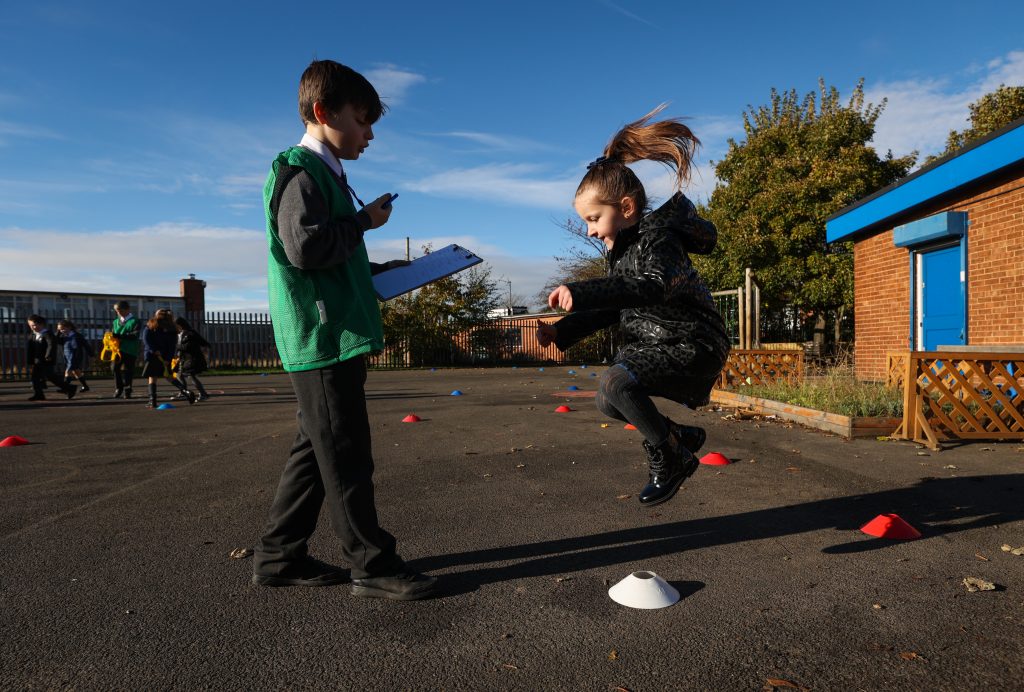
Aims of the PE Curriculum

At Key Stage 1 (Years 1-2) the national curriculum for PE aims to ensure that all:

Pupils should develop fundamental movement skills, become increasingly competent and confident and access a broad range of opportunities to extend their agility, balance and coordination, individually and with others. They should be able to engage in competitive (both against self and against others) and co-operative physical activities, in a range of increasingly challenging situations.

Pupils should be taught to:

  • master basic movements including running, jumping, throwing and catching, as well as developing balance, agility and co-ordination, and begin to apply these in a range of activities.
  • participate in team games, developing simple tactics for attacking and defending.
  • perform dances using simple movement patterns.
  • Formal elements

At Key Stage 2 (Years 3-6) the national curriculum aims for pupils are that:

Pupils should continue to apply and develop a broader range of skills, learning how to use them in different ways and to link them to make actions and sequences of movement. They should enjoy communicating, collaborating and competing with each other. They should develop an understanding of how to improve in different physical activities and sports and learn how to evaluate and recognise their own success.

Our approach underpins our belief that every pupil, regardless of background or barrier to learning, will thrive and reach their full potential. 

  1. Substantive knowledge – this is the subject knowledge and explicit vocabulary used to learn about the content. Common misconceptions are explicitly revealed as non-examples and positioned against known and accurate content as pupils become more expert in their understanding. Misconceptions are challenged carefully and in the context of substantive and disciplinary knowledge. 
  2. Disciplinary knowledge – this is the use of that knowledge and how children construct understanding through processes, evidence, pattern seeking, reasoning and explaining change. 
  3. Substantive concepts include: developing core stability, balance, agility, coordination, locomotor skills, shoulder stability, bilateral coordination, hand eye coordination and manipulative skills.  Concepts such as dodgeball require core and shoulder stability first, developing hand eye coordination alongside locomotive and manipulative skills. Finally this will lead onto tactical awareness through game based learning. 

PRINCIPLES

A guiding principle of P.E is that each concept builds upon each other, drawing on prior learning. In EYFS, we place a huge emphasis on developing the fundamental skills to allow children to develop their core stability, bilateral coordination, shoulder, elbow and wrist pivots to become ready to write. This is revisited and positioned so that new content and vocabulary build on the key principles taught in EYFS allowing children to progress onto manipulative skills, applying all skills to game based learning, developing leadership and tactical awareness. High volume and deliberate practice is essential for pupils to remember and retrieve substantive knowledge and use their disciplinary knowledge to explain and articulate what they know. This means pupils make conscious connections and think hard, using what they know. For example, in tag rugby, children in EYFS children develop their core stability, agility and hand eye coordination through the teaching of fundamental skills using equipment such as  slack lines, threading and manipulation of objects showing care and control. Within KS1, these skills are mastered and developed, including simple strategies, alongside manipulative skills through the use of equipment such as tag belts. In KS2, this substantive knowledge allows skill selection and application, tactics, strategies and compositional ideas to be developed alongside game based learning.

P.E equips pupils to become ‘more expert’ with each Unit and grow an ever broadening and coherent mental model of the subject. Specific and associated P.E vocabulary is planned sequentially and cumulatively from R to Y6. High frequency, multiple meaning words (Tier 2) are taught and help make sense of subject specific words (Tier 3). 
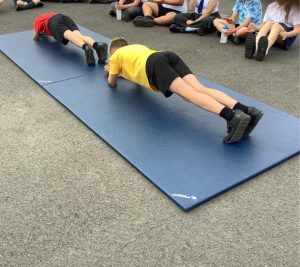
P.E is planned so that the retention of knowledge is much more than just ‘in the moment knowledge’. The cumulative nature of the curriculum is made memorable by the implementation of Bjork’s desirable difficulties, including retrieval and spaced retrieval practice, word building and deliberate practice tasks. This powerful interrelationship between structure and research-led practice is designed to increase substantive knowledge and accelerate learning within and between units. That means the foundational knowledge of the curriculum is positioned to ease the load on the working memory: new content is connected to prior learning. The effect of this cumulative model supports opportunities for children to associate and connect with the fundamental skill of P.E, allowing them to develop their tactical awareness.

AN EXAMPLE OF THE LONG-TERM SEQUENCE FOR P.E (Tag Rugby – Invasion Game)

Fundamental Movement EYFS

Invasion Games KS1

Invasion Games LKS2

Invasion Games UPKS2

EYFS

The sequence in EYFS places a huge emphasis on:

  • Fundamental skills where children are given opportunities to develop core stability, shoulder stability, bilateral coordination and hand eye coordination. 
  • Fine motor coordination working on hand strength, wrist positioning and pencil control. 
  • Locomotor skills include walking, running, hopping, skipping, jumping and dodging.  
  • Core stability, balance, agility and coordination.
  • https://cdn.realsmart.co.uk/npcat-stmarys/uploads/2022/01/06170151/242922814_193058919603690_6680166262230699585_n.mp4

Key Stage One

In KS1, the children build on the key principles they have been taught in EYFS and progress onto Manipulative skills including throwing, catching, kicking, underarm rolling etc.

They are also given opportunities to master the skills above, applying simple strategies to a range of games including invasion, net and wall and striking and fielding.
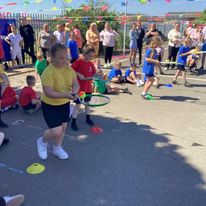
Lower Key Stage Two

In LKS2, the children continue to build upon the key principles taught in EYFS and KS. Opportunities are provided to develop their strategic knowledge, such as attacking and defending skills to apply these in a range of different sports.

Upper Key Stage Two

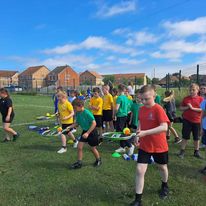
Moving into KS2, children will have the opportunity to master and apply all skills taught to date, participating in specific sports, developing leadership skills and tactical awareness.


Curriculum Overview

  • English
  • Reading
  • Phonics
  • Maths
  • Science
  • Art & Design
  • Computing
  • Design & Technology
  • French
  • Geography
  • History
  • Music
  • Physical Education
  • PSHE
  • RSE

Social Media

Comments Box SVG iconsUsed for the like, share, comment, and reaction icons

Goodbye to our incredible Year Six class of 2026 ⭐️

Good luck in your new schools, we know you will all achieve amazing things and we cannot wait to hear what the future holds for you!

#FiatMihi
... See MoreSee Less

3 weeks ago
Goodbye to our incre
View on Facebook
· Share
Share on Facebook Share on Twitter Share on LinkedIn Share by Email
View Comments likes love 71 Shares: 3 Comments: 17

17 CommentsComment on Facebook

Year One class of 2026 😎 ... See MoreSee Less

3 weeks ago
Image attachment
Image attachment
Image attachment
Image attachment
Image attachment
View on Facebook
· Share
Share on Facebook Share on Twitter Share on LinkedIn Share by Email
View Comments likes love 21 Shares: 0 Comments: 2

2 CommentsComment on Facebook

Well done to all our children with 100% attendance! ⭐️
#StMarysSuperStars
... See MoreSee Less

3 weeks ago
Image attachment
Image attachment
View on Facebook
· Share
Share on Facebook Share on Twitter Share on LinkedIn Share by Email
View Comments likes love 9 Shares: 0 Comments: 1

1 CommentsComment on Facebook

Load more
Find us
St. Mary's Catholic Primary School,
Tennyson Avenue, Grangetown, Middlesbrough, TS6 7AD
  • 01642 455309
  • [email protected]
  • Chair of Governors: Mrs J Manders

  • Executive Headteacher: Mrs A McClurey

  • Head of School: Mr N Bennett

  • Trust Business Manager: Mrs C Cunningham

  • School Office and Enquiries: Mrs L McNally / Mrs N Luxford

  • SENDCO: Mrs K Mendum

Trust Links

  • Trust Website
  • Trust Wide Policies
  • Trust Vision
  • Welcome from the CEO
  • Our Schools Websites
  • Our Schools Locations
Trust Logo
Diocese Logo

Trustees, Members, and Governors can be contacted via email: [email protected]

Freedom of Information Requests: [email protected]
Data Protection Requests: [email protected]


A paper copy of the information on this website can be provided on request.


Nicholas Postgate Catholic Academy Trust is an exempt charity regulated by the Secretary of State for Education. It is a company limited by guarantee, registered in England and Wales (company number 09203984) whose registered office is at Nicholas Postgate Catholic Academy Trust, Postgate House, Saltersgill Avenue, Middlesbrough. TS4 3JP

School website powered by Realsmart Logo